Product agility begins with structured user discovery
In the high-velocity world of PLG (Product Led Growth), rapid software iteration, and community-led development, the "bottleneck" is often the handoff between the Product or Research teams (who define the roadmap) and the Growth or Community teams (who have to gather the user data). Most PMs and UXRs maintain their feature taxonomies, stack-ranking instructions, and Likert anchors in a master PDF or a research brief. The friction occurs when a community manager or growth marketer has to manually retype those feature names, "tier" definitions, or segment tags into a Google Form for a new beta or a quarterly prioritization exercise.
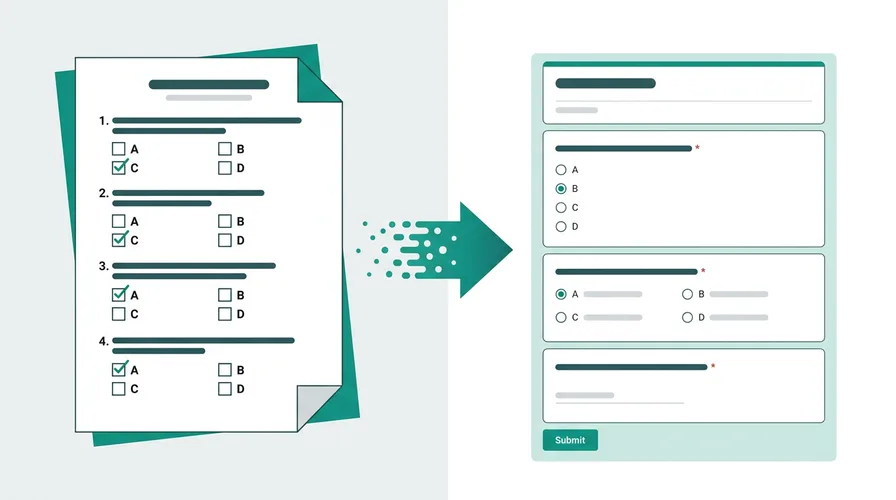
Doc2Form eliminates this "taxonomy drift" by reading your product brief or design document - up to 5 MB - and drafting a structured Google Form that mirrors your original structure and logic. This ensures that every beta user and every CAB (Customer Advisory Board) member captures feedback using identical definitions, which is mandatory for clean reporting and joining with backend event logs in tools like BigQuery or Looker Studio. By maintaining the same terminology as the source brief, you reduce the "cleanup time" required before every quarterly planning session or executive roadmap readout.
User Experience (UX) and Longitudinal Research Panels
Maintaining a consistent "Customer Voice" over months of usage or across different feature cohorts is a full-time job for UX researchers and product marketers. If your research lab defines a 1-7 "usability" or "perceived value" scale in a PDF, you need that wording to be identical in every survey you send to your recruited cohorts. Doc2Form brings those scale anchors into Google Forms with 100% accuracy, preventing "scale drift" where different PMs or squads use different adjectives for the same numerical score. This consistency is vital for tracking your NPS (Net Promoter Score) and CSAT (Customer Satisfaction) trends as you iterate on your core product.
You can also use Google Forms to manage recruitment for design partners, design councils, and "early-access" programs. By importing your company's standard design-partner packet and technical environment questionnaire, you ensure that every applicant is being screened against the same criteria - like "Self-serve SMB" or "Enterprise SSO requirement" - without having to rebuild the questionnaire for every new feature release. This transparency is vital for maintaining the quality of your research panels and ensuring that your qualitative insights reach the right product squads before the next sprint.
Sales Engineering and Technical Scoping Loops
Managing a network of "technical wins" and complex POCs (Proof of Concepts) requires consistent intake of integration requirements, idP (Identity Provider) details, and technical architecture diagrams. Instead of managing a flood of Slack threads or email attachments during a major enterprise sales cycle, you can convert your SE scoping PDF into a structured Google Form. By having prospects upload their architecture diagrams and security questionnaires directly into the Form, your engineering and security teams get a single, auditable folder in Google Drive for every pre-sales engagement.
This approach is particularly useful for managing internal "Demand Intake" and prioritization workshops. If your PMO or brand team uses a standard "Feature Value" or "Budget Allocation" instrument in a Word document, you can bring it into Google Forms in seconds. This ensures that every stakeholder report follows the exact same "knock-out" questions before a project is promoted to your development queue. Your data stays in your secure Google Drive, not on a third-party platform that might not meet your company's strict data-governance or GDPR standards.
Common questions
Does this replace our primary feedback tool like Productboard, Pendo, or Delighted?
No. Doc2Form is a productivity bridge for the "early discovery" and "specific cohort capture" phases. SaaS teams use Google Forms for fast, cohort-specific surveys, beta intakes, internal retros, or temporary research panels, and then manually export or use middleware like Zapier to move high-value data into their primary system of record. It's a tool for the "gaps" where your main system might be too rigid or doesn't have a simple, external-facing portal for non-users.
Can users upload log files or screenshots directly through the Form?
Yes. Once the Form is generated in Google Forms, you can add "File Upload" questions. This is mandatory for beta programs and technical triage where you need the user or SE to attach evidence of a UI bug, a performance trace, or a configuration error before the development team takes the case. Files land in a secure folder in your Google Drive, linked to the user's response.
How do we handle GDPR, CCPA, and PII in beta signups?
Because the Forms live in your own company's Google Workspace tenancy, you maintain full control over data residency and consent. We strongly recommend including your company’s standard privacy policy and data processing agreement (DPA) links in the Form description, especially for marketing-led waitlists or sensitive research panels. We also advise against collecting highly sensitive data like real names or payment details in plain-text Forms unless your Workspace security has been specifically hardened.
Can we use "Describe mode" for a flash roadmap or competitor poll?
Absolutely. If a major competitor launches a feature and you need a fast pulse on customer priority, or you want a quick answer on a new UI theme, you can type "3-question survey about [Topic] with priority 1-5, use case paragraph, and current plan tier dropdown" into Describe mode. Doc2Form will generate the structure so you can get a live link out to your user community in seconds.
What is the cost for a growth-stage startup or venture-backed firm?
Your first hosted conversion is free, allowing you to test your most complex design-partner screener. For product teams that need to digitize dozens of beta screeners, NPS surveys, and CAB questionnaires across multiple squads, we offer credit packs. The codebase is also open source for firms that prefer to host the tool on their own private developer infrastructure to meet strict corporate-governance or IP-protection rules.