Marketing velocity depends on structured stakeholder intake

In the world of demand generation, product marketing, and corporate communications, the "bottleneck" is often the gap between the strategy deck and the execution Form. Whether it is a creative request queue for the design team or a Go-To-Market (GTM) readiness checklist for a new feature, most marketing leaders rely on multi-page PDF roadmaps, Notion-based briefs, and Word-based SOPs. The friction occurs when a field marketer, sales rep, or partner has to "freestyle" an intake because the official request portal is too complex or undergoing an upgrade. The result is often a backlog of incomplete tickets missing critical metadata like target personas, localization requirements, or accurate CTA (Call to Action) text, leading to "clarification cycles" that burn marketing hours.

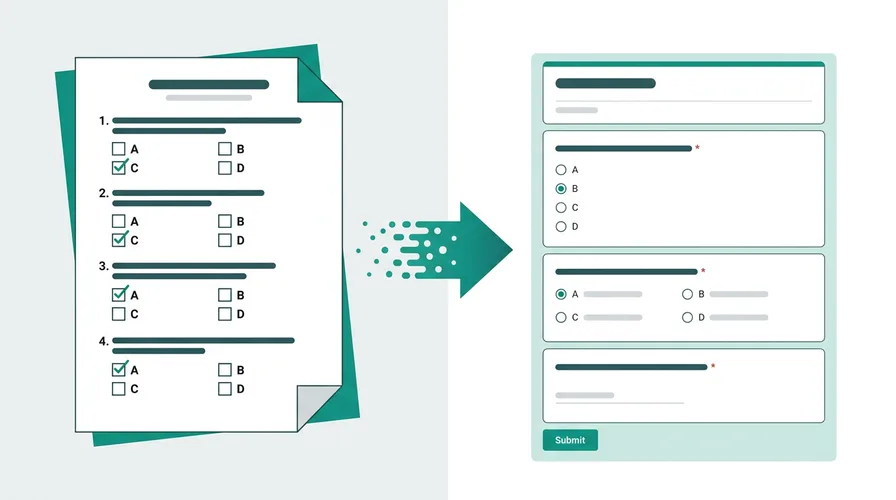
Doc2Form helps marketing leads move these scripts into structured Google Forms without a weekend of manual retyping. You upload the approved PDF or Word template - up to 5 MB - and Doc2Form builds a Form that mirrors your internal taxonomy, funnel stages, and asset specs. This ensures that every stakeholder and partner follows the exact same "knock-out" questions before a project is promoted to your creative or content queue. By maintaining the same terminology as the source script, you keep your "campaign-ready" documentation consistent across every department and region.

Launch Management: RACI Gates and Readiness Checklists

Maintaining a stable launch calendar and clear accountability requires consistent auditing of cross-functional readiness. If your GTM manual or RACI (Responsible, Accountable, Consulted, Informed) matrix has dozens of gate questions - from "Sales Enablement Assets Complete" and "Legal Review Signed" to "Localization QA Finished" - retyping those into a Google Form manually is an invitation for "complacent entry," where project owners skip sections that are hard to type. By importing the official slide-deck or Notion PDF directly, you ensure that every launch gate maps exactly to your internal playbook.

You can also use Google Forms to manage periodic win-loss interviews and customer discovery sessions. By starting with a canonical interview-guide PDF, you can organize the Form with scenario-based questions, Likert scales for competitor comparisons, and open-text blocks for "voice of customer" (VOC) quotes. The responses land in a linked Google Sheet where you can run Pivot Tables to trend feature requests and pain points by industry or segment, providing an auditable trail for product and marketing leadership reviews without the need for an expensive enterprise research tool.

Internal Demand and Priority Workshops Loops

The most actionable stakeholder feedback is that which is captured during the early discovery or "ideation" phase. If your PMM (Product Marketing Manager) or brand team provides a prioritization instrument or a "dot-voting" exercise in a Word document, you can bring it into Google Forms in seconds. You can then use the Form URL in your Slack or Teams channel to get immediate business-value justifications and technology-stack preferences into a Sheet that your leadership can trend in real-time. This flexibility allows CMOs and demand leads to use a single tool for everything from "Which events should we sponsor next year?" to "Rate our quarterly sales kickoff difficulty."

By digitizing your existing feedback and intake surveys, you maintain consistency in your operational history. If your firm’s "Annual Marketing Survey" has been using a 10-question PDF for years, importing that same PDF into Google Forms ensures that your longitudinal data on "Internal Alignment" remains comparable as you scale. Your data stays in your secure Google Drive, not on a third-party survey platform that might not meet your company's data-governance or infosec standards. This approach is particularly useful for managing shadow-IT discovery and "demand intake" where speed and structure are paramount.

Common questions

Does this replace our primary Project Management tool like Asana, Monday, or Jira?

No. Doc2Form is a productivity bridge for the "early discovery" and "stakeholder capture" phases. Marketing teams use Google Forms for fast, internal-facing intakes, readiness audits, or developer pulses, and then manually export or use middleware like Zapier to move high-value data into their primary system of record. It's a tool for the "gaps" where your main system might be too rigid or doesn't have a simple, mobile-friendly front end for field staff.

Can stakeholders upload briefs or creative assets directly through the Form?

Yes. Once the Form is generated in Google Forms, you can add "File Upload" questions. This is mandatory for creative requests and content discovery where you need the stakeholder to attach a draft brief, a specific asset requirement, or a competitor sample before the design team takes the case. Files land in a secure folder in your Google Drive, linked to the intake response.

How do we handle Salesforce or HubSpot integration for leads?

Doc2Form does not push records automatically to CRMs. We recommend using a middleware tool like Zapier or Make to move Form responses into your marketing automation platform, or using Google Sheets' native "Import" features if your operations team already has a reporting dashboard built in Sheets. Most teams use Forms for internal discovery and GTM gates that shouldn't clutter the CRM.

Can we use "Describe mode" for a flash internal pulse or name poll?

Absolutely. If you need a fast answer on a new campaign name, a lunch-and-learn topic, or a holiday party date, you can type "3-question survey about [Topic] with name checkboxes and feedback paragraph" into Describe mode. Doc2Form will generate the structure so you can get a live link out to your team's Slack or Teams channel in seconds.
What is the cost for an enterprise marketing group or global pod?

Your first hosted conversion is free, allowing you to test your most complex GTM checklist. For marketing operations that need to digitize large libraries of GTM checklists, creative intakes, and discovery guides across multiple product squads, we offer credit packs. The codebase is also open source for firms that prefer to host the tool on their own private developer infrastructure to meet strict corporate-governance or HIPAA rules.