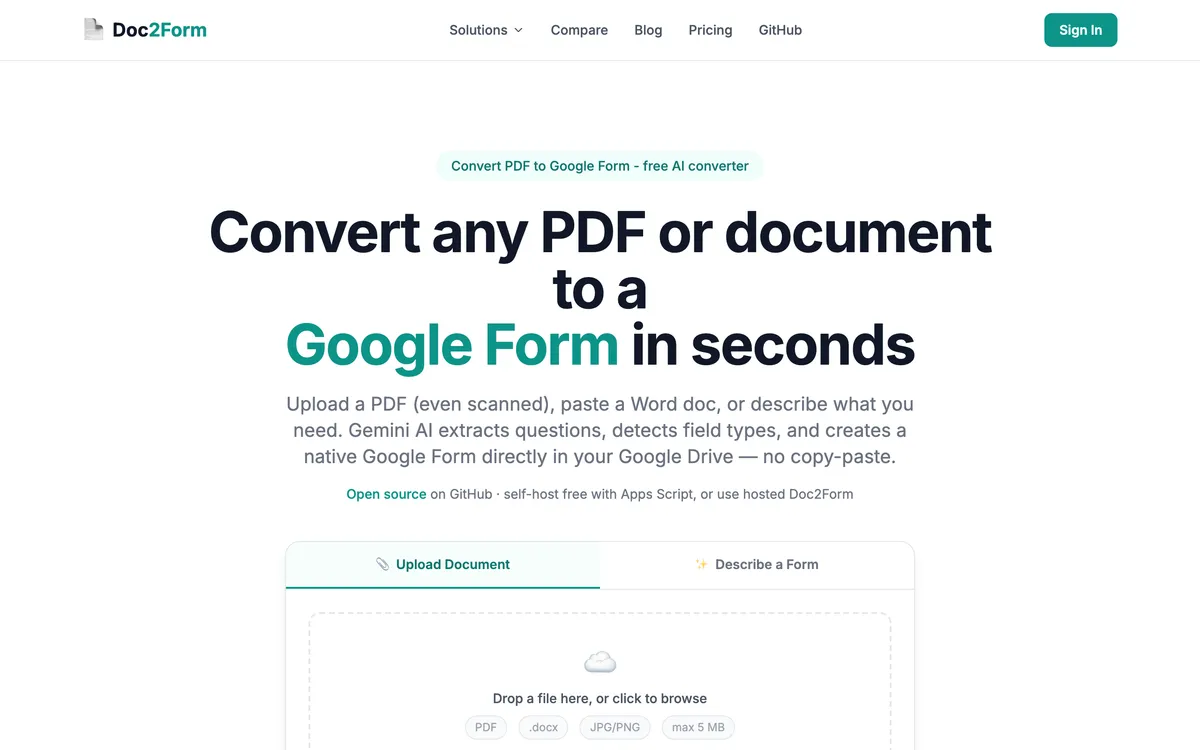
Doc2Form vs Typeform rarely fights over the same user, and it is worth saying why up front. Typeform sells branded, conversational forms hosted on typeform.com: one question at a time, careful typography, logic jumps, analytics, payment integrations. It is not a document converter. Doc2Form takes a PDF, Word file or image and lets you convert PDF to Google Form in your own Drive, usually in a couple of minutes.
The reason this comparison exists is that both tools show up when someone searches "turn my PDF into a form". Only one of them actually reads the PDF. But if what you want is a form people enjoy filling in, Typeform is the category leader and Doc2Form does not compete with it on that ground at all. Doc2Form's ceiling is whatever Google Forms can render, which is a plain, functional page.
In short
- Pick Doc2Form when you already have a document and the output has to be a native Google Form in your Drive, on a pay-per-form basis.
- Pick Typeform when how the form looks and how many people finish it matters more than which platform hosts it.
What is Typeform?
Typeform popularised the one-question-at-a-time form. Instead of a wall of fields, respondents see a single question filling the screen, answer it, and the next one slides in. That format, plus genuinely good default typography and spacing, is why Typeform forms tend to feel less like paperwork than a standard web form. The company has since built out logic jumps, recall of earlier answers into later questions, video and image questions, multi-step flows, and its own analytics on drop-off per question.
More recently Typeform has pushed into AI and workflow territory: an AI form builder that drafts a form from a prompt, plus automation flows that route and follow up on responses. It integrates broadly, including Zapier, HubSpot, Salesforce, Slack, Google Sheets and Stripe. Forms are hosted by Typeform and can be embedded on your site or served on a typeform.com URL, with custom domains on higher plans.
What Typeform does not do is import an existing document. There is no "upload this PDF and rebuild it" function. The practical workflow for a PDF is to open the file next to the builder and retype the questions, which is fine for six questions and painful for thirty-five. That is the specific gap Doc2Form fills.
Quick comparison: Doc2Form vs. Typeform
| Attribute | Doc2Form | Typeform |
|---|---|---|
| Output | Native Google Form | Typeform-hosted form |
| Lives in your Google Drive | ✅ | ❌ |
| Upload a PDF and get a form | ✅ | ❌ retype into the builder |
| Word (.docx) input | ✅ | ❌ |
| Image / phone photo input | ✅ JPG, PNG | ❌ |
| Scanned PDF (AI vision) | ✅ | ❌ |
| Generate from a text prompt | ✅ Describe mode | ✅ AI form builder |
| Conversational one-question-at-a-time UX | ❌ | ✅ |
| Design and brand control | Google Forms defaults only | ✅ Fonts, colours, custom domain |
| Completion and drop-off analytics | Basic Forms summary | ✅ Per-question drop-off |
| Logic jumps and answer recall | Basic Google Forms branching | ✅ |
| Video and image questions | Images only | ✅ |
| Payments | ❌ | ✅ Stripe integration |
| Zapier, webhooks, API | ❌ | ✅ |
| Google Classroom and Sheets native | ✅ | Via integration only |
| Open source and self-hostable | ✅ Apps Script | ❌ |
| Free tier | 1 form, no card | Free plan with tight response limits |
| Paid entry | Credit packs from $5, no subscription | Monthly or annual subscription |
Which tool should you pick?
| Your situation | Better fit | Why |
|---|---|---|
| You have a 30-question paper survey and need it live in Google Forms this afternoon | Doc2Form | Reads the file directly, including scans and photos, and writes a native Form into your Drive |
| You are collecting leads on a marketing site and completion rate is the metric you report on | Typeform | The conversational format and design polish exist specifically to reduce abandonment; a plain Google Form will not match it |
| Your form has to look like it belongs to your brand, on your own domain | Typeform | Custom fonts, colours, themes and custom domains; Doc2Form inherits Google Forms styling, which is a header image and an accent colour |
| A school or district requires student responses to stay inside Workspace | Doc2Form | The output is a Drive file under your own admin console, with no third-party form host holding the data |
| You need to see which question people abandon and iterate on it | Typeform | Per-question drop-off analytics is built in; Google Forms shows you response summaries, not funnel behaviour |
| You convert a few documents a year and do not want a recurring bill | Doc2Form | Credit packs start at $5 for 10 credits and credits never expire, with no subscription (check current pricing) |
| You want to pipe responses into HubSpot or Salesforce and trigger follow-ups | Typeform | Native integrations and automation flows; Doc2Form has no API, no Zapier and no webhooks |
| You have a photo of a paper quiz and need Classroom to grade it | Doc2Form | AI vision handles photographed pages, and the output is a real Google Forms quiz with an answer key |
| You need one form that takes payment and adapts questions based on the plan chosen | Typeform | Stripe plus logic jumps in one place; Google Forms cannot take payment at all |
Features compared: Doc2Form vs. Typeform
Getting a document into a form
This is the only part of the comparison where Doc2Form is straightforwardly ahead, because Typeform does not attempt it. Doc2Form accepts PDF, .docx and image files up to 5 MB and runs them through Gemini vision, so it does not depend on a clean text layer. A fax-quality scan or a phone photo of a worksheet is a normal input, not an edge case, which is why the scanned PDF to Google Form and image to Google Form paths exist.
Typeform's equivalent is its AI builder, where you describe the form you want and edit the draft. That is a good feature and Doc2Form has its own version of it in Describe mode, covered on the Google Form from a description page. But describing a form is not the same as converting one. If the authoritative version of the questions is a PDF someone else wrote, describing it from memory is not an option.
Doc2Form's own weak spot here is worth naming: complex matrix and grid blocks often come through as separate questions and need manual cleanup in the Forms editor.
Respondent experience, where Typeform wins outright
Typeform's whole product is the answer experience. One question per screen, smooth transitions, readable type, mobile-first layout, and logic that hides irrelevant questions so the form feels shorter than it is. Typeform publishes engagement claims of its own about completion rates compared to conventional forms; treat those as vendor marketing, but the underlying design advantage is real and obvious the moment you fill in both.
Doc2Form's output is a Google Form. It is clean, familiar, accessible enough for internal use, and it looks like every other Google Form. For a Classroom quiz or an internal ops intake, that familiarity is an asset. For a customer-facing campaign where the form is part of the brand impression, it is a liability, and no amount of conversion accuracy changes that.

Logic, integrations and everything after submission
Typeform handles what happens next: logic jumps, answer recall, hidden fields, response routing, notification rules, Zapier, native CRM connectors, Stripe payments, and its own analytics dashboard. Doc2Form stops the moment the Google Form exists. Everything after that is Google's: the Forms response summary, a linked Sheet, and whatever you build on top with Apps Script.
Doc2Form has no REST API, no webhooks, no Zapier connector and no bulk upload. If your workflow needs to react to submissions automatically outside Google, you are either writing Apps Script or you want Typeform.
Where the data lives and who reviews it
Doc2Form needs Google OAuth with the forms.body scope to create a form in your Drive. Some institutions will not approve that for a third-party app without a review, which is a real cost, not a footnote. Uploaded documents are processed to extract structure and then discarded, with only the form title and link retained. Because the project is open source Apps Script at github.com/kamilstanuch/doc2form, a security-conscious team can self-host it and avoid granting a token to anyone.
Typeform is a hosted processor: the responses live on Typeform's infrastructure and reach Google Sheets, if at all, through an integration that copies rows. For a marketing team that is unremarkable. For a school holding student data, or a team with a data-residency clause, it is the deciding factor and it points at Google Forms regardless of which builder is nicer.
Cost shape over a year
Typeform is a subscription with response limits per tier. Doc2Form is credits that never expire. Neither model is objectively better, they just suit different usage patterns: a marketing team running forms continuously gets value from every month of a Typeform plan, while a school office converting six documents a term would be paying twelve months for six jobs.
Pricing: Doc2Form vs. Typeform
| Doc2Form | Typeform | |
|---|---|---|
| Free tier | First form free, no card | Free plan, tight monthly response limit |
| Entry paid | $5 for 10 credits, one-time | Monthly or annual subscription |
| Mid | $12 for 30 credits, $29 for 100 credits | Higher tiers raise response limits and add features |
| Billing model | Credits, never expire, no subscription | Recurring subscription |
| What you are paying for | Each document converted | The hosted form platform and its response volume |
Prices move on both sides, so check current pricing before you commit. For a handful of conversions a year the maths is not close: a one-time credit pack beats any annual plan. For a team that lives in forms all year, Typeform's subscription is buying design, logic, analytics and integrations, and comparing it to a per-document credit price is comparing two different products.
Before you commit: Doc2Form vs. Typeform
Run a real test on both, with the file and the audience you actually have. Take one campaign form and build it in Typeform. Take one policy PDF and put it through Doc2Form. Then show marketing the Typeform completion dashboard and show IT where the personal data sits. Those two conversations usually settle it faster than a feature spreadsheet, and they often settle it in opposite directions for different forms.
Agencies frequently end up running both: Typeform for client-facing lead generation, Doc2Form for the compliance and onboarding PDFs that have to end up as Workspace artifacts. That is not indecision, it is two different deliverables.
If Section 508 or WCAG conformance is part of your procurement, review both against your own criteria rather than either vendor's summary. Google Forms has known limitations, and a conversational format has its own accessibility considerations around keyboard navigation and screen-reader flow.
The verdict: Doc2Form vs. Typeform
On form quality, Typeform wins and it is not particularly close. Better design, better respondent experience, real logic, real analytics, real integrations, payments. If your question is "which of these makes a better form", stop reading and go try Typeform.
Doc2Form wins one job: you have a document, the output has to be a native Google Form in your own Drive, and you do not want to retype it. Within that job it handles the inputs a builder cannot touch at all, including scans and photographs, and it charges per form instead of per month. Outside that job, it is the wrong tool and we would rather you knew that now.
Takeaway: Need a beautiful hosted form? Typeform. Need an existing document turned into a Sheets-linked Google Form in your Drive? Doc2Form.
Frequently asked questions
Should I just use Typeform instead?
If your priority is how the form looks and performs, yes. Typeform is a better form builder than anything Google Forms can produce, and Doc2Form does not change what Google Forms is capable of rendering. Choose Doc2Form only when the output format is the constraint: a native Google Form in your own Drive, built from a document you already have.
Can Typeform import a PDF and build the form for me?
No. Typeform has an AI builder that drafts a form from a written prompt, but there is no upload-a-document-and-convert-it function. For an existing PDF or Word file the practical Typeform workflow is retyping the questions into the builder, which is exactly the work Doc2Form removes.
Can Typeform output a Google Form file?
No. Typeform forms are hosted by Typeform. It can send responses to a Google Sheet through an integration, but that is copied data rather than a Google Forms file in your Drive, and it does not satisfy a requirement that says the artifact itself must live in Workspace.
Is Typeform cheaper for occasional PDF conversion?
Almost never, because it is not really doing the conversion. Paying a monthly subscription so you can manually retype four PDFs a year costs more in both money and hours than a $5 Doc2Form credit pack. Verify both vendors' current pricing, since plans change.
Can I get Typeform's look with Google Forms output?
No, and this is worth being blunt about. Google Forms allows a header image, a colour and a font choice, and that is roughly the extent of it. You can tidy up a Doc2Form conversion inside the Forms editor, but you cannot make it look like a Typeform. Pick which side of that tradeoff you care about more.
What about image to Google Form and other awkward inputs?
That is Doc2Form's clearest technical edge here. Slide photos, whiteboard captures and image-only PDFs go through vision extraction rather than needing a text layer, and Typeform has no comparable path because it does not ingest files at all. Expect to review the draft, particularly grid-style questions.
Which one should a teacher use?
Usually Doc2Form, for a specific reason: Google Classroom attaches and grades Google Forms quizzes natively, so a converted quiz to Google Form drops straight into an existing gradebook workflow. A Typeform would need to be shared as a link and scored separately. If the form is a parent-facing sign-up rather than a graded assessment, Typeform's polish is the stronger argument.
How do I get marketing to accept a Google Form?
Often you should not try. If the form is customer-facing and completion rate is a tracked metric, marketing's preference for Typeform is a reasonable business judgment rather than an aesthetic one. Save the Doc2Form argument for the internal and operational forms where the data has to stay in Workspace, and where the real cost is the hour someone spends retyping a PDF.
Try Doc2Form - first form free, no credit card.