Support velocity begins with structured ticket discovery
In the high-stakes world of customer service and support operations - in-house CX teams, BPO (Business Process Outsourcing) partners, and technical help centers - the "bottleneck" is often the gap between the initial contact and the resolution. Whether it is a multi-page Tier-0 triage tree, a high-velocity QA (Quality Assurance) scorecard, or a specialized CSAT (Customer Satisfaction) survey, support leads and quality managers often rely on PDF templates that have been meticulously refined by WFM (Workforce Management) leads, legal counsel, and product directors. The friction starts when an agent or a customer needs a fast, digital way to answer those questions without retyping the entire packet into a blank Google Form while on a live call or chat session. They often miss critical "symptom" prompts, skip billing verification acknowledgments, or use inconsistent terminology for "error codes," leading to resolution delays and administrative failures.
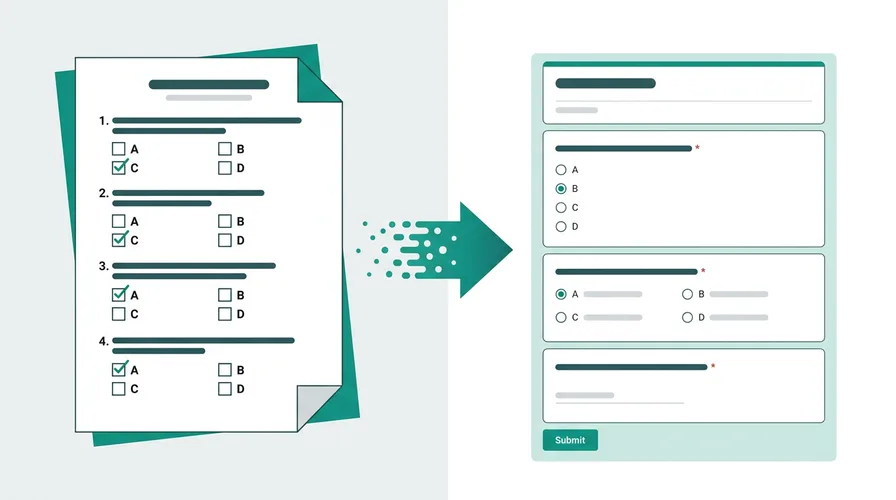
Doc2Form eliminates this "manual transcript" burden by reading your digitally authored PDF or Word templates - up to 5 MB - and drafting a structured Google Form in seconds. This ensures that every agent and every customer sees the exact same prompts your quality team approved, which is mandatory for maintaining service integrity and meeting SLA (Service Level Agreement) expectations. By maintaining the same terminology as the source script, you keep your "support-ready" documentation consistent from the first discovery call to the final resolution.
Service Integrity: Triage Trees, QA, and Agent Loops
Professional duty and administrative efficiency are only effective if they are documented consistently. If a quality manager has to wait for a physical audit card to be transcribed or a blurred scan of a triage script to be re-keyed into a CRM, the delay can lead to missed "must-know" resolution details or delayed remedial actions. By moving your intake scripts and internal health logs into Google Forms, you can provide a structured interface for agents to submit their details right from their browser. You can organize the Form by "Agent ID," "Case Type," and "Resolution Result," ensuring that every interaction is documented with an automatic Google timestamp and audit trail.
Importing your existing "Support Triage Macro" or "BPO Calibration Scorecard" PDF ensures that you are not missing critical prompts about empathy anchors, fatal error flags, or data-retention acknowledgments. Once the Form is generated, you can add "File Upload" questions so that agents can attach a photo of a bug report or a scan of a previous customer interaction, providing visual evidence that beats a handwritten note in a file. This transparency is vital for defending your support records and proving a robust quality-control culture to your board or regulatory body.
Compliance and Privacy: Ethics, HIPAA, and Data Governance in Support
Support teams handle the most sensitive information, from customer contact lists and billing details to internal strategy drafts and vulnerable-population data. Because the Forms live in your own organization's Google Workspace tenancy, you maintain full control over data residency, encryption, and access control. We strongly recommend ensuring your Workspace settings are configured for ethics and data-privacy compliance, and that your data officer has cleared the specific workflow for digital collection, especially for engagements under strict HIPAA or PII rules during triage.
By digitizing your existing feedback and intake surveys, you maintain consistency in your operational history. If your company’s "Annual Support Satisfaction Survey" has been using a 10-question PDF for years, importing that same PDF into Google Forms ensures that your longitudinal data on "Customer Effort" remains comparable as you scale. Your data stays in your secure Google Drive, not on a third-party survey platform that might not meet your company's strict data-governance or records-retention standards. This approach is particularly useful for managing non-sensitive workloads like internal training quizzes and agent feedback where speed and structure are paramount.
Common questions
Does this replace our primary CRM system like Zendesk, Salesforce, or Freshdesk?
No. Doc2Form is a productivity bridge for the "capture" and "discovery" phases that precede or follow the formal support record. Support teams use Google Forms for high-volume intake helpers, internal operational checks, or experience pulses, and then manually export or use API bridges to move key data into their system of record. It's a tool for the "gaps" where your main system might be too rigid or doesn't have a simple, mobile-friendly front end for agents.
Can agents or customers upload screenshots or logs through the Form?
Yes. Once the Form is generated in Google Forms, you can enable "File Upload" questions. This is mandatory for technical triage and discovery where you need the stakeholder to attach evidence of identity, a copy of previous logs, or a photo of a screen error before the project is authorized for review. Files land in a secure folder in your Google Drive, linked to the intake response. We recommend creating specific, restricted folders for this sensitive data.
How do we handle HIPAA and PCI compliance in Google Forms?
Google Forms provides a secure environment for data capture within your Workspace. However, we recommend designing your Forms for information gathering and triage checks rather than for the exchange of deep clinical data or highly sensitive payment card information. Your company’s IT policy should define which types of data are appropriate for Form collection versus more specialized, end-to-end encrypted support portals.
Can we use "Describe mode" for a flash agent poll or event RSVP?
Absolutely. If you need a fast pulse on agent interest for a new program or a quick answer on a holiday-party RSVP, you can type "3-question survey about [Topic] with guest name, meal preference dropdown, and reason text" into Describe mode. Doc2Form will generate the structure so you can get a link out to your team's Slack or email list in seconds.
What is the cost for a solo support lead or a multi-location BPO group?
Your first hosted conversion is free, allowing you to test your most complex QA scorecard survey. For support organizations that need to digitize large libraries of SOPs, intake forms, and training surveys across multiple programs, we offer credit packs. The codebase is also open source for firms that prefer to host the tool on their own private developer infrastructure to meet strict corporate-governance or ethics rules.