Technical precision needs structure before the trial begins

In the world of food manufacturing, sensory science, and CPG innovation, the "margin of error" is decided at the point of data capture. Whether it is a Central Location Test (CLT) for a new plant-based protein or a detailed allergen attestation for a global supplier, R&D and QA teams often spend hours manually retyping prompts from PDF protocols into a functional spreadsheet. The friction occurs when a sensory ballot retypes "Sweetness" as "Sugar Level," or a supplier survey uses a different unit of measure than the ERP expects, ruining your historical benchmarking and ANOVA (Analysis of Variance) prep.

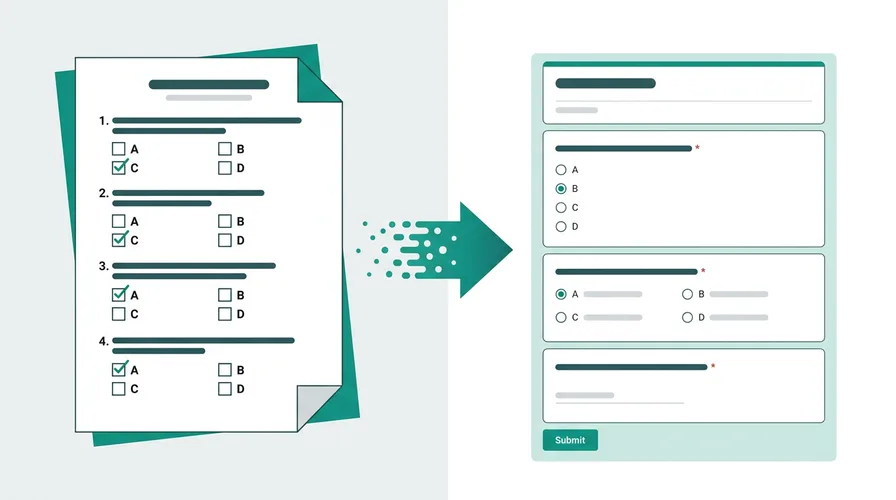
Doc2Form helps food and beverage teams bridge this gap by turning existing Word and PDF templates into structured Google Forms. Instead of re-keying 9-point hedonic scales, mouthfeel taxonomies, or facility audit rows, you upload the source file - up to 5 MB - and Doc2Form builds a Form that mirrors your lab’s approved terminology and logic. This means tasters, supervisors, and partners can complete their evaluations on their phones or tablets, and your statistics team gets a single, searchable Google Sheet of clean, timestamped data. By maintaining the same terminology as the source protocol, you ensure that every trial is comparable across different sites and shifts.

Quality Assurance and Food Safety: GMP and HACCP Walks

Maintaining SQF, BRC, or local health department standards requires consistent logging of line starts, sanitation checks, and "Good Manufacturing Practice" (GMP) walks. If your operations manual has daily checklist items - from "Footbath concentration" and "Metal detector verification" to "Locker room 5S" - retyping those into a Google Form manually is an invitation for "silent drift," where supervisors start skipping sections that are hard to type or use their own shorthand. By importing the official PDF or Word template directly, you ensure that every walk-down maps exactly to the SOP your food safety team controls.

Once the Form is generated, you can host it on a rugged tablet on the plant floor or at the line-start station. The responses land in Sheets with automatic Google timestamps, providing an auditable trail for third-party audits, insurance reviews, and FSMA compliance without the need for a complex proprietary LIMS (Laboratory Information Management System) or MES (Manufacturing Execution System). This transparency is vital for identifying equipment maintenance needs before they lead to product loss or safety non-conformities.

Consumer Insights and Sampling at Scale

The most actionable consumer feedback is that which is captured at the moment of tasting. If your brand or category marketing team provides a sampling survey instrument in a Word document, you can bring it into Google Forms in seconds. You can then use QR codes on tasting table tents at an expo, grocery demo, or industry event to get immediate "purchase intent" scores, flavor rankings, and "Why" prompts into a Sheet that your marketing team can trend in real-time. This flexibility allows brand managers to use a single tool for everything from "Rate our new seasonal roast" to "Which label design do you prefer for the 12oz format?"

By digitizing your existing consumer and trade surveys, you maintain consistency in your market research history. If your firm’s "Taste Test" has been using a 10-question PDF for years, importing that same PDF into Google Forms ensures that your longitudinal data on "Flavor Profile" remains comparable as you iterate on recipes. Your data stays in your secure Google Drive, not on a third-party platform that might not meet your company's data-governance or IP-protection standards.

Common questions

Does this replace our primary LIMS or ERP system like SAP, Oracle, or TraceGains?

No. Doc2Form is a productivity bridge for the "early capture" and "specific trial" phases. Food and beverage teams use Google Forms for high-volume audits, sensory panels, or supplier intakes, and then manually export or use API bridges to move key data into their system of record. It's a tool for the "gaps" where your main system might be too rigid or not mobile-friendly for the plant floor.

Can staff upload photos of defect modes or line issues directly through the Form?

Yes. Once the Form is generated in Google Forms, you can add "File Upload" questions. This is mandatory for GMP audits and supplier discovery where you need the supervisor or auditor to attach evidence of a sanitation failure, a maintenance requirement, or a facility non-conformity before a corrective action (CAPA) is authorized. Files land in a secure folder in your Google Drive, linked to the audit response.

How do we handle food defense, visitor logs, and non-disclosures?

We strongly recommend including your facility's standard food defense and non-disclosure language in the Form description if you are collecting info for a plant tour or a supplier visit. Google Forms timestamps provide proof of acknowledgment, providing a digital alternative to the paper visitor log in the front lobby. For high-stakes trade secrets, you can include a required checkbox for NDA agreement that maps directly to your counsel-approved wording.

Can we use "Describe mode" for a flash tasting panel or line check?

Absolutely. If your beverage director suddenly needs a "gold standard" check on a new batch or a quick pulse on line clearance after a changeover, you can type "Tasting ballot with sweetness 1-9, off-flavor checkboxes, and taster ID text" into Describe mode. Doc2Form will generate the structure so you can get a live link out to your panel or supervisors in seconds.
What is the cost for a large manufacturer or multi-site copacker?

Your first hosted conversion is free, allowing you to test your most complex HACCP checklist. For manufacturing sites that need to digitize large libraries of HACCP logs, sensory ballots, and supplier intakes across multiple facilities, we offer credit packs. The codebase is also open source for firms that prefer to host the tool on their own private developer infrastructure to meet strict corporate-governance or IP-protection rules.