Retail agility needs structure before the sale is finalized
In the high-velocity world of brick-and-mortar stores, Direct-to-Consumer (DTC) brands, and marketplace operations, the "bottleneck" is often the gap between HQ's operational manuals and the front-line associate. Whether it is a Return Merchandise Authorization (RMA) triage or a complex vendor compliance checklist, store teams and warehouse staff often spend hours manually retyping prompts from PDF SOPs into functional spreadsheets or blank Google Forms. The friction occurs when a warranty form retypes "Symptom" as "Problem," or a vendor survey uses a different warehouse code than the ERP expects, ruining your backend tracking and inventory reconciliation.
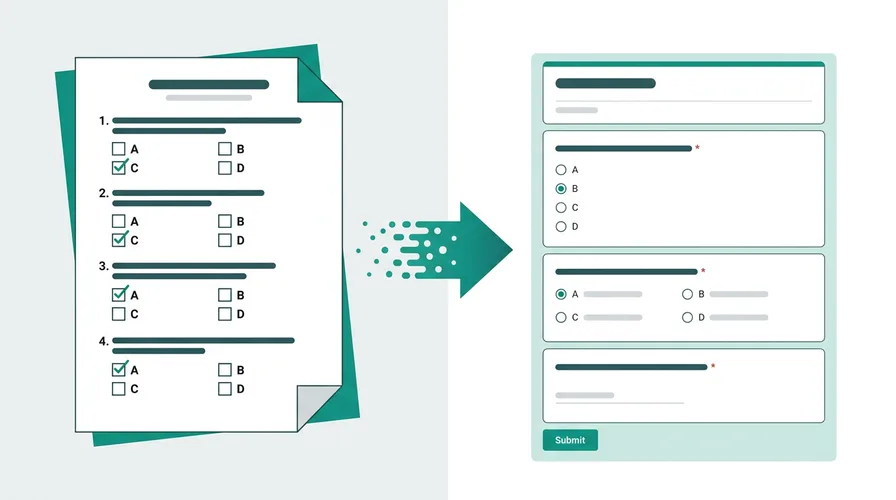
Doc2Form helps retail operations bridge this gap by turning existing Word and PDF templates into structured Google Forms. Instead of re-keying product return reasons, seasonal availability grids, or damage claim fields, you upload the source file - up to 5 MB - and Doc2Form builds a Form that mirrors your company’s approved terminology and logic. This means customers, associates, and partners can complete their intakes on their phones or tablets, and your back-office team gets a single, searchable Google Sheet of clean, timestamped data. By maintaining the same terminology as the source script, you ensure that every return or audit is comparable across different stores and regions.
Customer Feedback and "Voice of the Store"
Actionable customer feedback is most useful when it is captured at the moment of the transaction or interaction. If your marketing or loyalty team provides a post-purchase survey instrument in a Word document, you can bring it into Google Forms in seconds. You can then use QR codes on receipts, printed on shopping bags, or displayed at the fitting room to get immediate "satisfaction" scores, associate ratings, and "Why" prompts into a Sheet that your regional managers can trend in real-time. This flexibility allows GMs to use a single tool for everything from "How was your fitting room experience?" to "Which new product line would you like to see next?"
You can also use Google Forms to manage internal communications and "Store Walks" between the field and HQ. By importing your standard store-walk or "Perfect Store" audit PDF, you ensure that every floor manager is evaluating their department against the same criteria - like "Visual Merchandising Compliance," "Safety Hazard Checks," and "Signage Accuracy" - without having to rebuild the questionnaire for every seasonal refresh. The responses land in a central tab where regional VPs can identify top-performing stores and training gaps before the quarterly board meeting.
Vendor Onboarding and Marketplace Seller Compliance
Managing a network of marketplace sellers, regional vendors, or "dropship" partners requires consistent intake of business licenses, insurance certificates, and EDI (Electronic Data Interchange) contact info. Instead of managing a flood of email attachments in a general procurement inbox, you can convert your vendor onboarding packet into a structured Google Form. By having partners upload their COIs and diversity certifications directly into the Form, your supply chain team gets a single, auditable folder in Google Drive for every season.
This approach is particularly useful for managing seasonal hiring and shift preferences. If your store managers use a laminated "Blackout Date" or "Shift Bid" grid, you can digitize it in seconds. Associates can then submit their availability from their own devices, and the manager gets a structured Sheet that can be used to build the weekly schedule in minutes, rather than hours of manual transcription. Your data stays in your secure Google Drive, not on a third-party platform that might not meet your company's data-governance standards.
Common questions
Does this replace our primary POS, OMS, or WMS like Shopify, NetSuite, or Manhattan?
No. Doc2Form is a productivity bridge for the "capture" and "survey" phases of retail ops. Most teams use Google Forms for fast, lightweight intakes, RMA triage, or store audits, and then manually export or use middleware like Zapier to move high-value data into their primary system of record. It's a tool for the "gaps" where your main system might be too rigid or doesn't have a mobile-friendly front end for the floor.
Can associates upload photos of damaged shipments or displays directly through the Form?
Yes. Once the Form is generated in Google Forms, you can add "File Upload" questions. This is mandatory for receiving-dock checklists and "Perfect Store" audits where you need the associate to attach evidence of a crushed carton, a missing pallet, or a correctly executed endcap display before the task is marked complete. Files land in a secure folder in your Google Drive, linked to the audit response.
How do we handle omnichannel order lookups and validation?
We recommend including a required "Order ID" field in your Form. By providing a validation hint (e.g., "Must start with #") in the Google Forms description after import, you ensure that the data exported to your OMS is clean and matches your order database format. You can also use Sheets' native VLOOKUP features to join Form responses with your master order list for real-time reconciliation.
Can we use "Describe mode" for a flash clearance event or VIP night?
Absolutely. If you are running a weekend sidewalk sale or a "First Access" event for loyalty members and do not have a PDF master yet, you can type "RSVP for [Brand] clearance event with email, size preference, and favorite category dropdown" into Describe mode. Doc2Form will generate the structure so you can get a live signup link out to your local customers in seconds.
What is the cost for a national retail group or regional chain?
Your first hosted conversion is free, allowing you to test your most complex store-walk audit. For groups that need to digitize dozens of store audits, HR intakes, and vendor questionnaires across hundreds of locations, we offer credit packs. The codebase is also open source for firms that prefer to host the tool on their own secure developer infrastructure to meet strict corporate-governance or PCI-DSS rules.