Service velocity depends on structured discovery

In the world of IT Service Management (ITSM), platform engineering, and enterprise shared services, the "margin of error" is decided at the point of intake. Whether it is a Change Advisory Board (CAB) risk assessment, a major-incident triage script, or a new-hire equipment request, most IT teams rely on multi-page PDF catalogs and Word-based SOPs. The friction occurs when an agent or requester has to "freestyle" an intake because the official ITSM portal is too rigid, undergoing an upgrade, or simply doesn't exist for a specific new service. The result is often incomplete tickets missing critical metadata like CI (Configuration Item) names, impact urgency, or accurate "blast radius" estimates, leading to breached SLAs and "ping-pong" effect between engineering squads.

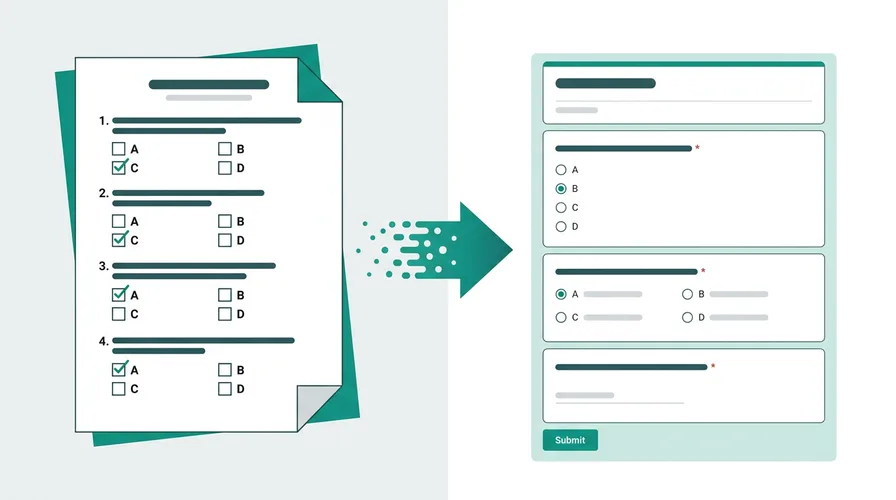
Doc2Form helps IT leads move these scripts into structured Google Forms without a weekend of manual retyping. You upload the approved PDF or Word template - up to 5 MB - and Doc2Form builds a Form that mirrors your internal ITIL taxonomy and risk scoring. This ensures that every service desk agent or platform user follows the exact same "knock-out" questions before a ticket is promoted to your system of record. By maintaining the same terminology as the source script, you keep your "support-ready" documentation consistent across every department and region.

Change Management: CAB Risk, Backout Plans, and Post-Mortems

Maintaining a stable production environment requires consistent auditing of proposed changes and thorough documentation of outages. If your CAB manual or Incident Post-Mortem template has dozens of risk questions - from "Security Impact" and "Resource Availability" to "Validation Steps" and "Rollback Plan" - retyping those into a Google Form manually is an invitation for "complacent entry," where requesters skip sections that are hard to type or use their own shorthand. By importing the official policy PDF directly, you ensure that every change record and incident retro maps exactly to your ITIL standard.

You can also use Google Forms to manage periodic access recertifications and Segregation of Duties (SoD) attestations. By starting with a canonical system-access PDF, you can organize the Form with yes/no grids for managers to review their team's entitlements. The responses land in a linked Google Sheet where you can run VLOOKUPs against your IAM (Identity and Access Management) data, providing an auditable trail for internal security reviews without the need for an expensive enterprise GRC (Governance, Risk, and Compliance) tool. This transparency is vital for identifying orphan accounts and maintaining "audit-ready" access logs.

Internal Demand and Platform Discovery Loops

The most actionable business feedback is that which is captured during the early discovery or "ideation" phase. If your PMO or platform team provides a project-intake instrument or a developer-experience survey in a Word document, you can bring it into Google Forms in seconds. You can then use the Form URL in your Slack or Teams channel to get immediate "T-shirt sizes," business-value justifications, and technology-stack preferences into a Sheet that your leadership can trend in real-time. This flexibility allows CIOs and platform leads to use a single tool for everything from "Which SaaS apps do you want to sunset?" to "Rate our deployment pipeline's reliability."

By digitizing your existing feedback and intake surveys, you maintain consistency in your operational history. If your firm’s "Annual IT Survey" has been using a 10-question PDF for years, importing that same PDF into Google Forms ensures that your longitudinal data on "Internal CSAT" remains comparable as you scale. Your data stays in your secure Google Drive, not on a third-party survey platform that might not meet your company's data-governance or infosec standards. This approach is particularly useful for managing shadow-IT discovery and "demand intake" where speed and structure are paramount.

Common questions

Does this replace our primary ITSM tool like ServiceNow, Jira Service Management, or Freshservice?

No. Doc2Form is a productivity bridge for the "early discovery" and "specific intake" phases. IT teams use Google Forms for fast, lightweight intakes, risk audits, developer pulses, or temporary outage reporting, and then manually export or use middleware to move high-value data into their primary system of record. It's a tool for the "gaps" where your main system might be too rigid or doesn't have a mobile-friendly front end for field staff.

Can we collect log files, screenshots, or config files directly through the Form?

Yes. Once the Form is generated in Google Forms, you can add "File Upload" questions. This is mandatory for incident triage and change validation where you need the user or agent to attach a screenshot of the error, a diagnostic dump, or a signed backout plan before the ticket is moved to the next stage. Files land in a secure folder in your Google Drive, linked to the ticket response.

How do we handle secrets, admin credentials, or sensitive network data?

We strongly advise against collecting full passwords, API keys, or raw admin credentials in plain-text Forms unless your company's Workspace tenancy has been specifically hardened and cleared for that workload. Use Forms for the discovery metadata (e.g., "Which system has the issue?") and then use your company's approved vaulting or PAM (Privileged Access Management) process for the final sensitive exchange.

Can we use "Describe mode" for a flash outage or migration poll?

Absolutely. If a major system goes down and you need a fast pulse on impact across different departments, or you want a quick answer on a migration window preference, you can type "3-question survey about [System] with department dropdown, user count numeric, and workaround status" into Describe mode. Doc2Form will generate the structure so you can get a link out to your business partners in seconds.
What is the cost for an enterprise IT group or MSP?

Your first hosted conversion is free, allowing you to test your most complex change-request form. For IT operations that need to digitize large libraries of service catalogs, CAB forms, and access reviews across multiple departments, we offer credit packs. The codebase is also open source for firms that prefer to host the tool on their own private developer infrastructure to meet strict corporate-governance or HIPAA rules.