Aviation safety requires zero-drift documentation

In the aerospace and aviation industry - MRO, OEM, and airline operations - the "margin of safety" is built on disciplined adherence to controlled documents. Whether it is a line-maintenance "helper" checklist, a high-stakes internal quality audit, or a recurrent training attestation, most organizations rely on multi-page PDF Standard Operating Procedures (SOPs) and Word-based field manuals. The friction starts when a technician, auditor, or study lead has to manual retype those prompts into a functional spreadsheet or a blank Google Form. They often paraphrase critical details like Minimum Equipment List (MEL) references, AS9100 finding categories, or specific tool calibration requirements, leading to non-conformities during surveillance audits and regulatory inspections.

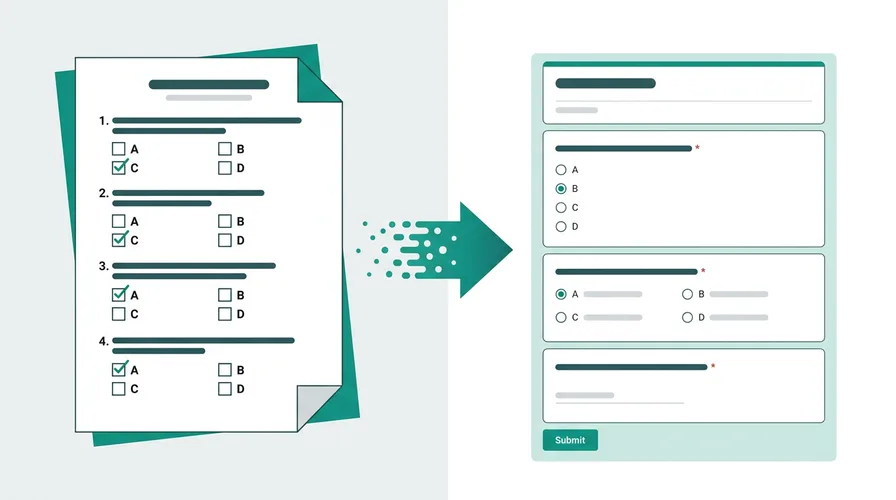
Doc2Form eliminates this "manual drift" by reading your released PDF or Word templates - up to 5 MB - and drafting a structured Google Form in seconds. This ensures that every hangar, field station, and lab captures data using identical terminology, which is mandatory for maintaining your Part 145, Part 121, or AS9100 certifications. By maintaining the same terminology as the source script, you ensure that your technical data is "audit-ready" for the FAA, EASA, or your prime customer’s quality team.

Quality Assurance: Internal Audits, CAPA, and Safety Walks

Safety Management Systems (SMS) are only as good as the quality of the data feeding them. If a quality auditor or safety lead has to wait for a physical clipboard to be returned to the office before findings are logged, the delay can hinder immediate corrective actions (CAPA) and lead to missed "near-miss" reporting windows. By moving your audit scripts and safety-walk checklists into Google Forms, you can provide a structured interface on a phone or tablet. You can organize the Form by "Work Environment," "Tool Control," "Technical Data," and "FOD (Foreign Object Debris) Prevention," ensuring that every station is evaluated against the same criteria.

Importing your existing "Quality Audit" or "Line Maintenance" PDF ensures that you are not missing critical prompts about calibrated tooling, shelf-life limited parts, or specialized PPE. Once the Form is generated, you can add "File Upload" questions so that auditors can attach a photo of a discrepancy, a tool serial number, or a part tag, providing visual evidence that beats a handwritten note when presenting a finding to the accountable manager. This transparency is vital for defending your safety record and proving a robust compliance culture.

Training, Technical Discovery, and Supplier Vetting

Beyond the hangar floor, aviation firms handle a significant volume of recurring training attestations and vendor capability surveys. If your training department or procurement lead uses a Word-based human factors quiz, a dangerous goods acknowledgment, or an AS9102-style supplier questionnaire, Doc2Form can bring it into Google Forms in seconds. By providing a simple link instead of a PDF attachment, you increase participation rates from distributed staff and get structured data into Sheets that your training manager can use to update the master skills matrix or your AVL (Approved Vendor List).

By digitizing your existing feedback and discovery surveys, you maintain consistency in your operational history. If your firm’s "Recurrent Training" has been using a 10-question PDF for years, importing that same PDF into Google Forms ensures that your longitudinal data on "Knowledge Gaps" remains comparable as you scale. Your data stays in your secure Google Drive, not on a third-party platform that might not meet your company's strict cybersecurity or ITAR (International Traffic in Arms Regulations) standards.

Common questions

Does this replace our primary MRO or ERP system like AMOS, Ramco, or SAP?

No. Doc2Form is a productivity bridge for the "front-line capture" phase. Aviation teams use Google Forms for high-volume internal audits, training checks, or vendor intakes, and then manually export or use API bridges to move key data into their enterprise system of record. It's a tool for the "gaps" where your main system might be too rigid or doesn't have a mobile-friendly front end for the ramp.

Can technicians use the Form offline in the hangar or on the ramp?

Google Forms generally requires a Wi-Fi or cellular connection. We recommend that technicians save the Form as a shortcut on their mobile devices. For areas with zero connectivity, we advise maintaining a paper backup for the immediate safety check and then syncing the data once signal is restored. Most facilities find that hangar-wide Wi-Fi or LTE is sufficient for the 30-second submission time required for most field forms.

How do we handle FAA, EASA, or ITAR-sensitive data?

Doc2Form does not decide whether a given collection may live in Google Workspace; your quality and cyber-security teams do. We recommend using Doc2Form only for non-critical business processes, internal-facing audits, or training acknowledgments that your CISO has already cleared for the cloud. The Forms and response data live in your own firm's Google Workspace tenancy, not on Doc2Form's servers. We advise against collecting highly sensitive proprietary design data or classified details in plain-text Forms.

Can we collect photos of tool serial numbers or part tags?

Yes. Once the Form is generated in Google Forms, you can enable "File Upload" questions. This is mandatory for tool control and receiving inspections where you need the technician to attach evidence of a calibration sticker, a part serial number, or a shipping discrepancy before the task is marked complete. Photos land in a secure folder in your Google Drive, accessible only to authorized quality staff.
What is the cost for a multi-site MRO group or tier supplier?

Your first hosted conversion is free, allowing you to test your most complex audit checklist. For organizations managing multiple hangars or a large library of controlled documents, we offer credit packs. The codebase is also open source for firms that prefer to host the tool on their own private developer infrastructure to meet strict corporate-governance or IP-protection rules.