Agency velocity begins with structured methodology
In the high-churn world of SEO, performance marketing, and content strategy, the "margin of error" is decided during the audit and briefing phases. Whether it is a technical site crawl checklist or a content discovery brief, most agencies rely on multi-page PDF methodologies, slide-deck appendices, and Notion-based templates. The friction occurs when an analyst, writer, or account manager has to manually retype those "schema requirements," "internal linking goals," or "SME interview questions" into a Google Form for the client or the execution team. They often miss critical entities, skip Core Web Vitals (CWV) rows, or use inconsistent terminology for "crawl issues," leading to expensive rework and missed search-intent targets.
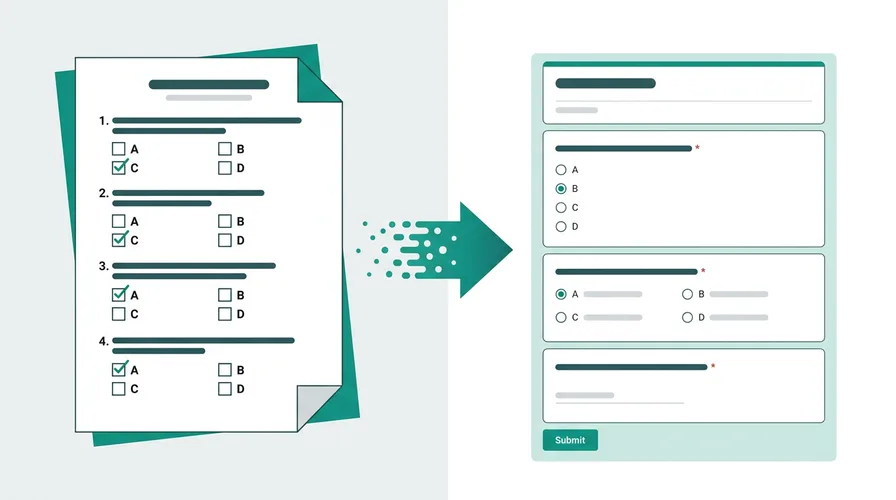
Doc2Form eliminates this "methodology drift" by reading your agency's approved PDF or Word templates - up to 5 MB - and drafting a structured Google Form in seconds. This ensures that every analyst, writer, and client sees the exact same prompts your strategy lead approved, which is mandatory for maintaining a consistent "agency standard" and avoiding "mis-briefs" that burn billable hours. By maintaining the same terminology as the source script, you keep your "client-ready" documentation consistent from the pitch to the QBR.
Content Operations: SEO Briefs, SME Discovery, and Review Loops
Editorial SEO is a game of precision and rapid iteration. If a writer or freelancer has to "freestyle" a content brief because the official Notion-based template is too complex or undergoing a version update, the result is often a post that misses key semantic entities, search-intent triggers, or conversion opportunities. Most teams maintain these briefing "checklists" as internal PDFs or Word documents. By moving your briefs into Google Forms, you can provide a structured interface for writers to submit their drafts and SME (Subject Matter Expert) notes right from their browser.
Importing your existing "Content Brief" or "Technical Audit" PDF ensures that you are not missing critical prompts about primary keywords, secondary entities, internal-link targets, or specific competitor comparisons. Once the Form is generated, you can add "File Upload" questions so that writers can attach a draft doc or a SERP (Search Engine Results Page) screenshot directly to the intake. The data lands in a central Google Sheet that your editorial manager can use to trend content performance and track production pacing in real-time, providing an auditable trail for "client-ready" reporting without the need for a complex proprietary content-marketing suite.
New Business and Client Feedback Loops
The relationship with a client does not end when the contract is signed or the technical audit is delivered. Top-tier digital agencies use onboarding surveys and post-engagement surveys to track satisfaction, client expectations, and technical environment details. If your discovery manual has a standard set of intake questions or a QBR (Quarterly Business Review) feedback instrument, you can convert that Word template into a Google Form in seconds. By sending a simple link instead of a PDF attachment, you increase response rates from busy CMOs and get structured data into Sheets that your account leads can use for agency-wide quality improvement.
By digitizing your existing feedback and onboarding surveys, you maintain consistency in your client history. If your firm’s "Annual SEO Performance Review" has been using a 10-question PDF for years, importing that same PDF into Google Forms ensures that your longitudinal data on "Agency Trust" remains comparable as you scale. Your data stays in your secure Google Drive, not on a third-party survey platform that might not meet your company's strict data-governance or client-NDA standards. This approach is particularly useful for managing white-label audits and "new business" discovery where speed and structure are paramount.
Common questions
Does this replace our primary SEO tool like Ahrefs, Semrush, or Screaming Frog?
No. Doc2Form is a productivity bridge for the "human analysis" and "client capture" phases. Digital agencies use Google Forms for fast, client-facing intakes, analyst audits, or experiment retros, and then manually export or use API bridges to move high-value data into their reporting tools or BI dashboards. It's a tool for the "gaps" where your main system might be too rigid or doesn't have a simple, external-facing portal for non-users.
Can clients upload GA4 screenshots or Search Console data directly through the Form?
Yes. Once the Form is generated in Google Forms, you can add "File Upload" questions. This is mandatory for discovery where you need the client to attach a screenshot of their historical performance, a specific site-map requirement, or a GSC (Google Search Console) export before the strategy team starts the audit. Files land in a secure folder in your Google Drive, linked to the client's discovery response.
How do we handle Looker Studio or data-lake integration?
Doc2Form does not push records automatically. We recommend using Google Sheets' native "BigQuery" or "Looker Studio" connectors to move Form responses into your agency's reporting dashboards, or using middleware like Zapier if you have a custom data pipeline. Most agencies find that a Sheet-based rollup is sufficient for the "qualitative observations" that feed the QBR deck.
Can we use "Describe mode" for a quick site-survey or partnership poll?
Absolutely. If you need a fast answer on a new niche or a potential backlink partnership, you can type "3-question survey about [Topic] with site URL, niche dropdown, and authority rating 1-10" into Describe mode. Doc2Form will generate the structure so you can get a live link out to your prospecting team or freelancers in seconds.
What is the cost for a multi-service digital agency or freelancer?
Your first hosted conversion is free, allowing you to test your most complex technical audit. For agencies managing dozens of client intakes and QBR surveys across multiple departments (SEO, PPC, Content), we offer credit packs. The codebase is also open source for firms that prefer to host the tool on their own private developer infrastructure to meet strict corporate-governance or client-NDA rules.