Professional guarding depends on structured incident capture

In the security and protective services industry - guarding, investigations, and corporate EHS - the "margin of safety" is decided by the clarity and consistency of the field report. Whether it is a Daily Activity Report (DAR) or a high-stakes Use-of-Force narrative, most guarding firms and corporate security departments rely on multi-page PDF post-orders and Word templates. The friction starts when an officer or investigator has to "freestyle" an incident report in a blank mobile app or paper logbook. They often miss critical metadata like exact timestamps, lighting conditions, or witness contact info, leading to "narrative drift" that can hurt an officer's credibility in court or during a client SLA (Service Level Agreement) review.

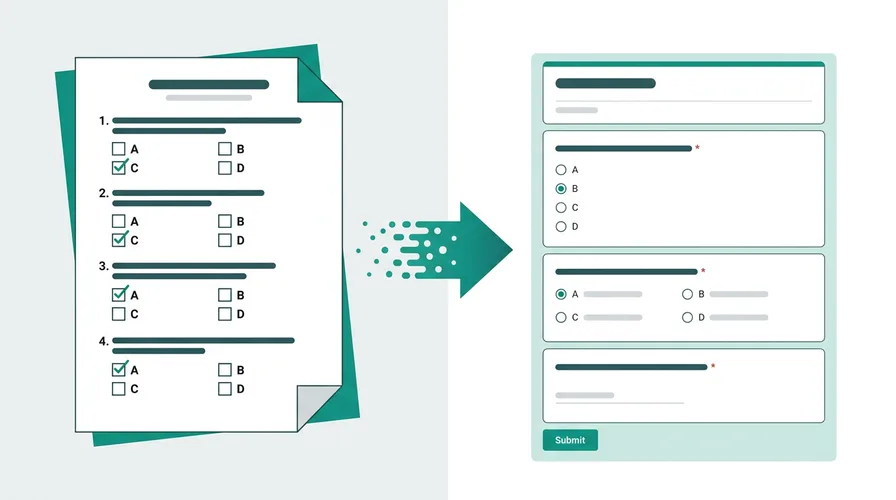
Doc2Form eliminates this risk by reading your counsel-approved PDF or Word templates - up to 5 MB - and drafting a structured Google Form in seconds. This ensures that every officer and every shift captures incident data using identical terminology, which is mandatory for maintaining evidentiary integrity and meeting client expectations. By maintaining the same terminology as the source script, you ensure that your field data is "audit-ready" for the client, the insurance carrier, or the legal system.

Field Work: DARs, Patrol Checkpoints, and Incident Narratives

Patrol documentation and incident reporting are only effective if they are completed in real-time or immediately after an event. If an officer has to wait until the end of their shift to retype their notes from a paper logbook, the risk of "memory drift" and missing details is high. By moving your DARs and incident forms into Google Forms, you can provide a structured interface on a phone or rugged handheld. You can organize the Form by "Checkpoint ID," "Vehicle Pass Count," and "Maintenance Flags," ensuring that every round is documented with an automatic Google timestamp.

Importing your existing "DAR" or "Use of Force" PDF ensures that you are not missing critical prompts about fire-extinguisher pressure, gate-lock integrity, or de-escalation steps taken. Once the Form is generated, you can add "File Upload" questions so that officers can attach a photo of a broken window, a suspicious vehicle, or a recovered item, providing visual evidence that beats a handwritten note when presenting a report to the client. This transparency is vital for defending your firm’s performance and proving a robust security culture.

Quality Assurance: Client Audits and Training Quizzes

Maintaining a high standard of service requires consistent auditing of site performance and officer readiness. If your account manager uses a standard "Client Compliance" or "Site Audit" PDF for quarterly reviews, Doc2Form can bring it into Google Forms in seconds. By providing a structured interface for site walks, you can organize findings by "Staffing Compliance," "Uniform Standards," and "Technical Readiness," ensuring that every client site is evaluated against the firm's global standard.

By digitizing your existing training refreshers and license-renewal surveys, you maintain consistency in your workforce history. If your firm’s "Post-Order Quiz" has been using a 10-question PDF for years, importing that same PDF into Google Forms ensures that your longitudinal data on "Officer Proficiency" remains comparable as you scale. Your data stays in your secure Google Drive, not on a third-party platform that might not meet your company's strict data-governance or evidentiary-chain standards. This approach is particularly useful for managing decentralized site-specific post-orders where data privacy is paramount.

Common questions

Does this replace our primary guard-tour or dispatch software like Trackforce, Silvertrac, or Heliaus?

No. Doc2Form is a productivity bridge for the "front-line capture" and "client audit" phases. Security teams use Google Forms for high-volume DARs, internal safety checks, or training quizzes, and then manually export or use API bridges to move key data into their enterprise system of record. It's a tool for the "gaps" where your main system might be too rigid or doesn't have a mobile-friendly front end for temporary or remote sites.

Can officers use the Form offline in remote patrol areas or basements?

Google Forms generally requires a data or Wi-Fi connection. We recommend that officers save the Form as a shortcut on their mobile devices. For areas with zero connectivity, we advise maintaining a paper backup for the immediate incident and then syncing the data once signal is restored. Most facilities find that LTE or facility-wide Wi-Fi is sufficient for the 30-second submission time required for most field forms.

How do we handle evidentiary or chain-of-custody data?

Doc2Form does not make Google Forms a "certified" evidence management system. We recommend using it for the initial field intake and narrative capture that precedes formal record-keeping. Your legal team and IT group decide what electronic acknowledgments and file-storage rules are appropriate for your specific chain-of-custody and records-retention policies.

Can we collect photos of badges or ID cards directly through the Form?

Yes. Once the Form is generated in Google Forms, you can enable "File Upload" questions. This is mandatory for visitor intake and personnel audits where you need to attach a photo of a badge, a license, or a training certificate before the task is marked complete. Photos land in a secure folder in your Google Drive, accessible only to authorized staff. We recommend creating specific, restricted folders for this sensitive PII.
What is the cost for a large guarding firm or corporate security group?

Your first hosted conversion is free, allowing you to test your most complex incident report. For firms managing dozens of site-specific post-orders and DARs across multiple regions, we offer credit packs. The codebase is also open source for organizations that prefer to host the tool on their own private developer infrastructure to meet strict corporate-governance or IP-protection rules.