Technical precision begins at the production cell
In the world of Lean manufacturing, ISO quality standards, and continuous improvement, the "margin of error" is often decided by the quality of your field data. Whether it is a Layered Process Audit (LPA) or a daily Gemba walk, most plant managers and quality engineers distribute their checklists as PDFs or Excel-based forms. The friction occurs when a supervisor or operator has to manual retype that audit into a blank Google Form on a tablet at the end of a shift. They often miss a critical "must-ask" question, use different terminology for "scrap reason" codes, or skip the comment box for corrective actions.
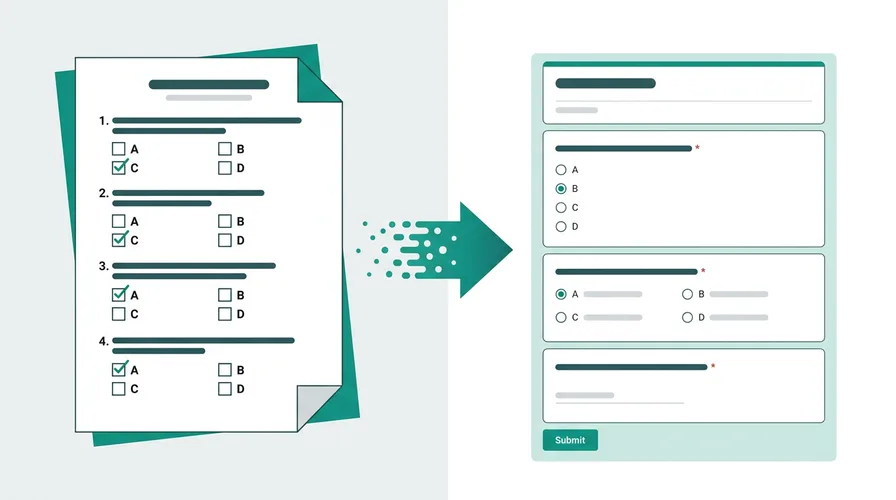
Doc2Form eliminates this "manual friction" by reading your quality-approved PDF or Word templates - up to 5 MB - and drafting a structured Google Form that mirrors the original sections and logic. This ensures that every shift and every facility captures data using identical definitions, which is mandatory for clean auditing and Root Cause Analysis (RCA) later in the production cycle. By maintaining the same terminology as the source control plan, you ensure that your quality data is "audit-ready" for ISO surveillance or customer visits.
Quality Assurance: LPAs, Gemba Walks, and 5S Audits
Layered Process Audits (LPAs) are only effective if they are completed on schedule and against the current revision of the process control plan. If a supervisor has to wait for a physical clipboard to be passed around the plant floor, the temptation to "pencil whip" the audit at the end of the day is high. By moving your LPAs into Google Forms, you can provide a QR code at each production cell. Leads can tap through the hazard checks and process verifications on their own mobile devices, and you get a real-time record in a Google Sheet.
Importing your existing LPA PDF ensures that you are not missing critical prompts about tool calibration, safety guards, or material labeling. Once the Form is generated, you can add "File Upload" questions so that auditors can attach a photo of a defect mode or a 5S violation, providing visual evidence that beats a handwritten note in a binder every time. This transparency is vital for maintaining your PFMEA (Process Failure Mode and Effects Analysis) integrity and proving your quality culture to auditors.
Production Logs and OEE Tracking
Maintaining a high Overall Equipment Effectiveness (OEE) depends on consistent logging of scrap, rework, and downtime. If your production log or "hourly board" is a complex Word document or Excel sheet, Doc2Form can turn those tables into structured Form sections. You can organize the Form by "Product Family," "Reason Code," and "Operator ID," making it easy for staff to submit data without leaving the production line.
The responses roll up into a central Google Sheet that your CI (Continuous Improvement) coach can use to trend downtime reasons and calculate scrap costs in real-time. This data is mandatory for managing "claims-ready" documentation, and having it in a structured digital format is much more valuable than a folder full of scanned logbooks during an ISO surveillance visit. Your data stays in your secure Google Drive, not on a third-party platform that might not meet your firm's data-governance or IP-protection standards.
Common questions
Does this replace our primary MES or QMS like SAP, Plex, or MasterControl?
No. Doc2Form is a productivity bridge for the "front-line capture" phase. Manufacturing teams use Google Forms for high-volume audits, safety observations, or internal checklists, and then manually export or use RPA (Robotic Process Automation) to move key data into their enterprise system of record. It's a tool for the "gaps" where your main system might be too rigid or not mobile-friendly for the plant floor.
Can operators use the Form offline on the factory floor?
Google Forms generally requires a Wi-Fi or data connection. We recommend that operators save the Form as a shortcut on their home screen. For areas with zero connectivity, we advise maintaining a paper backup for the immediate safety check and then syncing the data once signal is restored. Most facilities find that plant-wide Wi-Fi is sufficient for the 30-second submission time required for most audit forms.
How do we handle 21 CFR Part 11 or GxP compliance?
Electronic records rules are organizational. If Google Forms is not validated for your specific GxP use case, we recommend using Doc2Form only for non-regulated or internal operational workflows. Your quality unit and IT group decide what is appropriate for your specific data-integrity and electronic-signature policies. Many firms use Forms for 5S and Gemba while keeping batch records in validated systems.
Can staff upload photos of defect modes or 5S issues?
Yes. Once the Form is generated in Google Forms, you can enable "File Upload" questions. We recommend creating specific folders in Google Drive for each production line so that photos are automatically organized by department and timestamp. This makes it easy to find the "before and after" photos for a Kaizen event or a CAPA investigation.
What is the cost for a multi-plant manufacturing group?
Your first hosted conversion is free, allowing you to test your most complex audit checklist. For groups managing multiple sites or a large library of quality documents, we offer credit packs. The codebase is also open source for firms that prefer to host the tool on their own private Workspace infrastructure to meet strict corporate-governance or IP-protection rules.