Related conversion guides: PDF to Google Form · Intake PDF to Google Form · Document to Google Form
In short: Convert engineering services PDF and Word templates into Google Forms in your Drive. Doc2Form drafts structure from files up to 5 MB so teams stop retyping rfp and rfq intakes, site surveys and discipline walk-downs, design review and ifc punch. Not a replacement for your primary system of record. First form free.
Engineering services packets should not mean rebuilding every Form
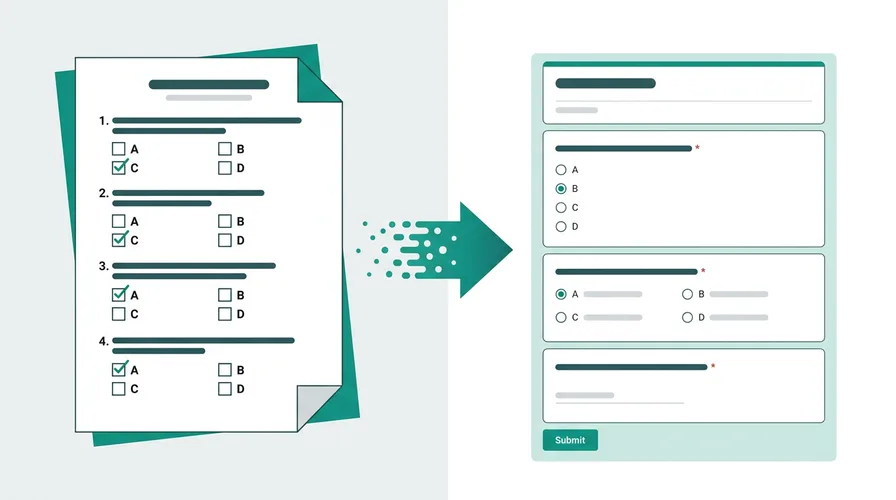
Engineering services teams usually keep the official wording in a PDF or Word file that went through review. The digital experience people want is a Google Form link. In the middle is someone retyping fields, which introduces mistakes and version drift.
Doc2Form reads a digitally authored file and maps sections into a Form you finish in Google Forms. Common starting points: rfp and rfq intakes; site surveys and discipline walk-downs; design review and ifc punch. Describe mode helps when you need a short survey without a source file.
Based on a sample of 1,775 Google Forms generated by Doc2Form users, containing 55,761 questions across 47 languages. That is an average of 31 questions per form - roughly 21 minutes saved per form versus rebuilding each question by hand in the Forms editor (assuming ~40 seconds per question).
Where responses sit, and what we do not claim
Every Form lands in Google Drive like any form you build yourself. Link responses to Sheets when you need exports. Doc2Form is not your primary system of record. Blurry scans and complex tables may need a cleanup pass. Collect only what your policy allows.
Sources
- Google Forms API - native Forms created in your Drive after structure is extracted.
- Gemini API - document structure analysis for questions, options, and sections.
- Google Workspace for Education / business - Forms and Sheets stay under your org's Google account policies.
Common questions
Does this replace BIM 360, Procore, or Bluebeam?
No. Doc2Form is a productivity bridge for the "capture" and "survey" phases that precede or follow the BIM model.
Can we collect signatures for professional certifications or seals?
Google Forms allows for name entry and checkboxes which act as a digital acknowledgment. For formal "Sealed" submittals or PE-stamped documents, we recommend following up the Form intake with your firm's approved e-signature and document control platform.
How do we handle confidential site photos and sensitive client data?
Because the Forms live in your own firm's Google Workspace tenancy, you maintain full control over data residency and access. We strongly recommend including your firm's standard non-disclosure agreement (NDA) and data processing links in the Form description.
Can we use "Describe mode" for a quick scoping call or discovery?
Absolutely. If a client calls with a rush project and you do not have a PDF master yet, you can type "10-question site survey for solar farm with acreage, utility tie-in point text, and fence height" into Describe mode.