Security hygiene begins with structured stakeholder intake
In the world of GRC (Governance, Risk, and Compliance), Security Operations (SOC), and security awareness, the "margin of safety" is decided by the quality of your discovery data. Whether it is a Third-Party Risk Management (TPRM) questionnaire for a new SaaS vendor or a post-incident "first report" from a business user, most security teams rely on multi-page PDF risk packs, Word-based SOPs, and legacy spreadsheets. The friction occurs when a vendor or employee has to "freestyle" an intake because the official GRC portal is too complex, undergoing a migration, or simply doesn't exist for a specific new threat. The result is often incomplete submissions missing critical metadata like SOC2 report dates, data-classification flags, or accurate "containment status" details, leading to increased risk exposure and "follow-up fatigue" for your security analysts.
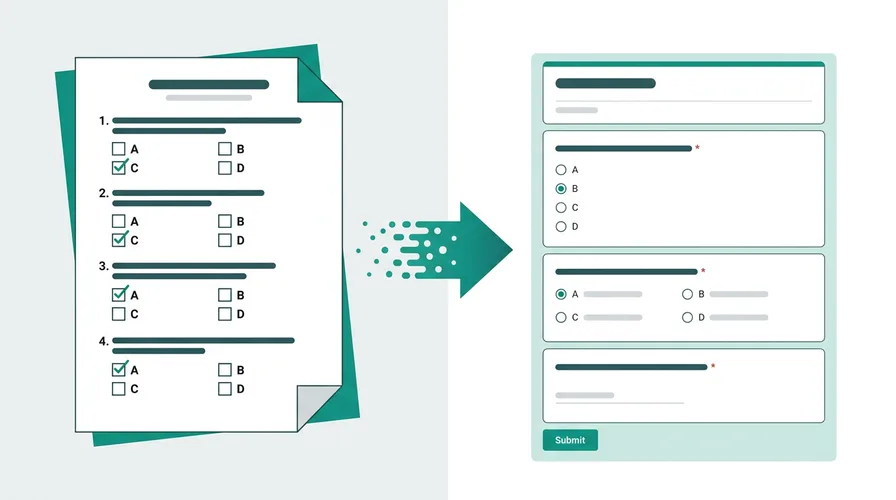
Doc2Form helps security leads move these scripts into structured Google Forms without a weekend of manual retyping. You upload the approved PDF or Word template - up to 5 MB - and Doc2Form builds a Form that mirrors your internal control taxonomy and risk-scoring rubric. This ensures that every vendor or staff member follows the exact same "knock-out" questions before a risk is promoted to your system of record. By maintaining the same terminology as the source script, you keep your "audit-ready" documentation consistent across every department and acquisition.
Risk Management: TPRM, SIG Lite, and Compliance Attestations
Maintaining a stable third-party ecosystem requires consistent auditing of vendor controls and periodic attestation of internal policies. If your SIG (Standardized Information Gathering) manual, CAIQ (Consensus Assessments Initiative Questionnaire), or Annual Policy Review has dozens of risk questions - from "Encryption at Rest" and "MFA Enforcement" to "Background Check Policy" and "Incident Response Plan" - retyping those into a Google Form manually is an invitation for "synonym drift," where vendors or employees misunderstand the requirement. By importing the official policy PDF directly, you ensure that every risk record and attestation maps exactly to your internal security standard.
You can also use Google Forms to manage periodic security awareness quizzes and phishing drill attestations. By starting with a canonical training PDF, you can organize the Form with scenario-based questions, distractors, and automatic grading. The responses land in a linked Google Sheet where you can run VLOOKUPs against your HR roster, providing an auditable trail for internal security reviews and insurance renewals without the need for an expensive enterprise training LMS (Learning Management System). This transparency is vital for identifying high-risk departments and tailoring your awareness programs.
Internal Triage and Business Continuity Discovery Loops
The most actionable security feedback is that which is captured during the early triage or "discovery" phase. If your SOC team provides an incident-intake instrument or a business-continuity survey in a Word document, you can bring it into Google Forms in seconds. You can then use the Form URL in your Slack or Teams channel to get immediate "incident severity," "system impact," and "containment progress" details into a Sheet that your responders can act on in real-time. This flexibility allows CISOs and risk owners to use a single tool for everything from "Which vendors handle our employee PII?" to "Rate our quarterly phishing drill difficulty."
By digitizing your existing feedback and triage surveys, you maintain consistency in your operational history. If your firm’s "Security Culture Survey" has been using a 10-question PDF for years, importing that same PDF into Google Forms ensures that your longitudinal data on "Risk Perception" remains comparable as you scale. Your data stays in your secure Google Drive, not on a third-party platform that might not meet your company's strict data-residency or SOC2 standards. This approach is particularly useful for managing shadow-IT discovery and "vendor capture" where speed and structure are paramount.
Common questions
Does this replace our primary GRC tool like OneTrust, Archer, or RiskRecon?
No. Doc2Form is a productivity bridge for the "early discovery" and "vendor capture" phases. Security teams use Google Forms for fast, lightweight risk intakes, internal audits, awareness checks, or temporary threat reporting, and then manually export or use middleware like Zapier to move high-value data into their primary system of record. It's a tool for the "gaps" where your main system might be too rigid or doesn't have a simple, external-facing portal for small vendors.
Can we collect SOC2 reports, pen-test results, or COIs through the Form?
Yes. Once the Form is generated in Google Forms, you can add "File Upload" questions. This is mandatory for vendor risk reviews and compliance audits where you need the third party to attach evidence of their security posture, insurance standing, or diversity certification before the contract is approved by legal. Files land in a secure folder in your Google Drive, linked to the risk response.
How do we handle classified, highly sensitive threat data, or credentials?
We strongly advise against collecting classified material, admin credentials, API keys, or raw PII in plain-text Forms unless your company's Workspace tenancy has been specifically hardened and cleared for that workload. Use Forms for the discovery metadata (e.g., "Which system has the vulnerability?") and then pivot to your company's approved encrypted channel or vaulting process for the final sensitive exchange.
Can we use "Describe mode" for a flash vulnerability or zero-day poll?
Absolutely. If a major zero-day is announced and you need a fast pulse on impact across different product squads, or you want a quick answer on patching status, you can type "3-question survey about [Vulnerability] with system name, patching status dropdown, and exposure level 1-5" into Describe mode. Doc2Form will generate the structure so you can get a link out to your engineering partners in seconds.
What is the cost for a corporate security group or SOC?
Your first hosted conversion is free, allowing you to test your most complex vendor questionnaire. For security operations that need to digitize large libraries of TPRM forms, policy attestations, and awareness quizzes across multiple business units, we offer credit packs. The codebase is also open source for firms that prefer to host the tool on their own private, air-gapped infrastructure to meet strict corporate-governance or HIPAA rules.